

Happy Overshoot Day?
This post is written by Henry Sipos, VIU student and NCAH Intern.
It’s time to call the bank for a loan because we’ve already blown our 2026 budget!
No, Overshoot Day is not a new holiday to celebrate and be happy about. In fact, it should be a deeply troubling day for Canadians.
What is Overshoot Day?
Canada’s Earth Overshoot Day marks the point in the year—if everyone on Earth lived like Canadians do—that humanity’s demand for ecological resources would exceed what Earth can regenerate in a year. This year that date falls this Sunday, March 8th, 2026.
If we look at Country Overshoot Days for 2026, Canada is sixth on the list (three spots higher on the list than the U.S.!). In 2025, the date fell on March 26, almost three weeks later. In one year, Canada moved up six places on the list, meaning our ecological footprint relative to Earth capacity has worsened. This is not the kind of list on which we want our country to be moving upward!
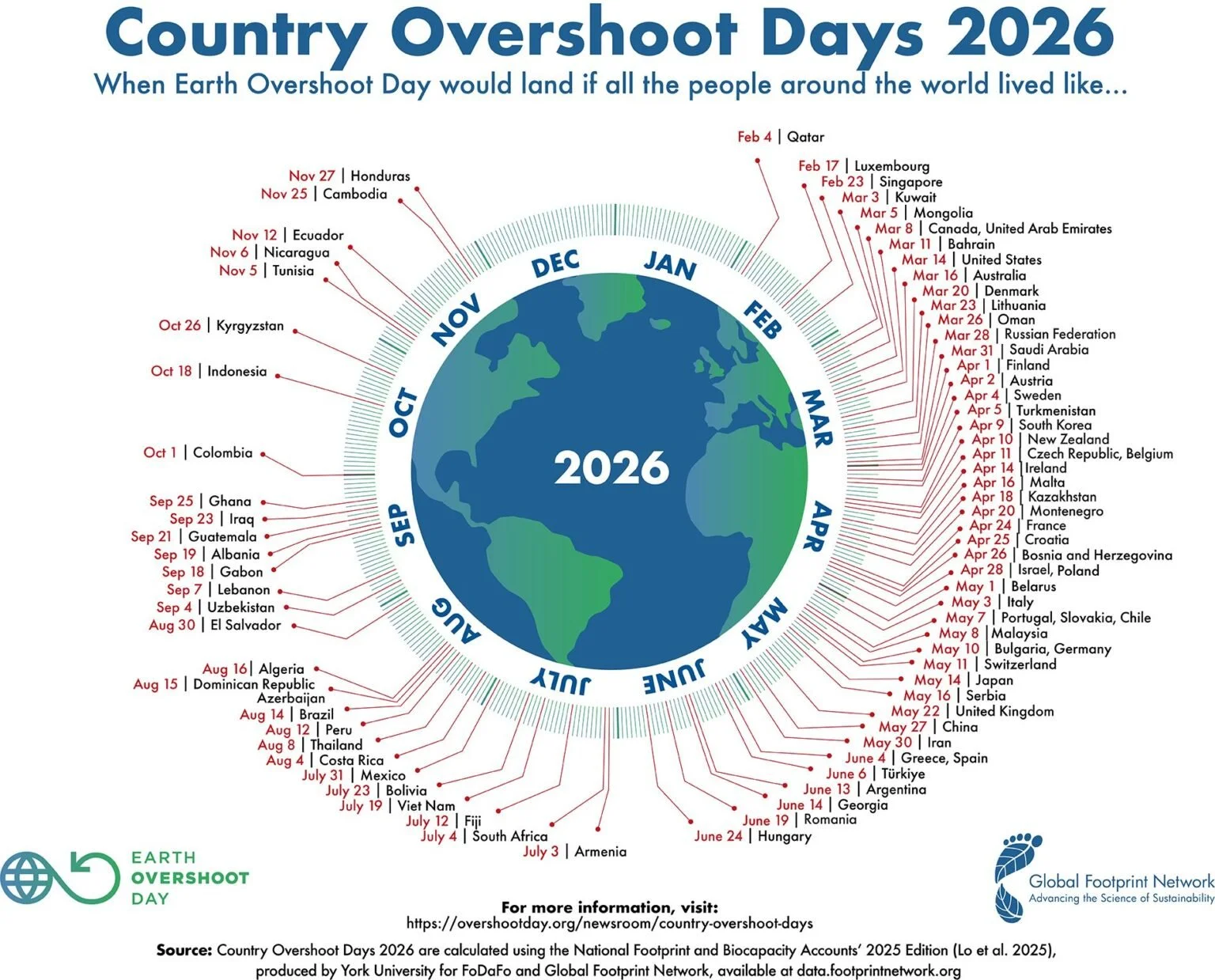
This ecological deficit means that Canadians have a large ecological footprint and are living beyond Earth’s annual biocapacity ‘budget’. To call this unsustainable is an absurd understatement. At this rate, humanity would need 5.5 Earths to sustain a Canadian lifestyle (the last time I checked we only had one).
Some countries do not have an Overshoot Day, as their consumption remains within Earth’s regenerative budget. This means that if everyone on Earth had the same ecological footprint as those countries, humanity would stay within the Earth ecological ceiling. However, this does not necessarily mean those countries represent sustainable nor desirable systems. As we well know, much of the population on the planet does not have access to the resources necessary for well-being. Overshoot highlights this imbalance; Canadians should not feel good that our excess gets somewhat balanced out by others’ lack of what they need to meet their basic needs.
Many countries without an Overshoot Day fall short in social foundations. The majority of these countries are developing nations located in Africa and South Asia, including Bangladesh, Nigeria, Nepal, and Ethiopia. These countries operate within the planetary boundary, not because of environmental innovation, but because they generally have lower levels of industrialization and consumption contributing to a smaller ecological footprint. While they remain within Earth’s ecological ceiling, their people are struggling to meet essential needs and reach adequate social foundations.
Overshoot and Doughnut Economics
Earth Overshoot Day focuses only on ecological limits; it does not explicitly account for human or social needs.The Doughnut Economics framework is very much concerned with the ability for humans to live, work and thrive within planetary limits. This is what is meant by the expression “living within the Doughnut”. How do we not overshoot, while ensuring that the fundamental needs—rights— of humans (such as access to water, health, food, housing, and social justice) are met? We’re talking striking a well-being balance between humans and broader ecological systems. And while the framework is not perfect (for example, it lacks Indigenous perspectives), when considered alongside Earth Overshoot Day, it reinforces the need for a paradigm shift.
Nanaimo is the only city in Canada, possibly North America, to have formally adopted Doughnut Economics as its operating model. The framework is the basis for the City Plan and informs the monitoring strategy the city uses to understand, and take action, on key well-being metrics. The Nanaimo Monitoring Bar (Nanaimo Bar… get it?) tracks a range of metrics from GHG emissions to water use to community safety. This is Nanaimo’s first step in ensuring we play our part in reducing overshoot, while ensuring our citizens’ needs are met.
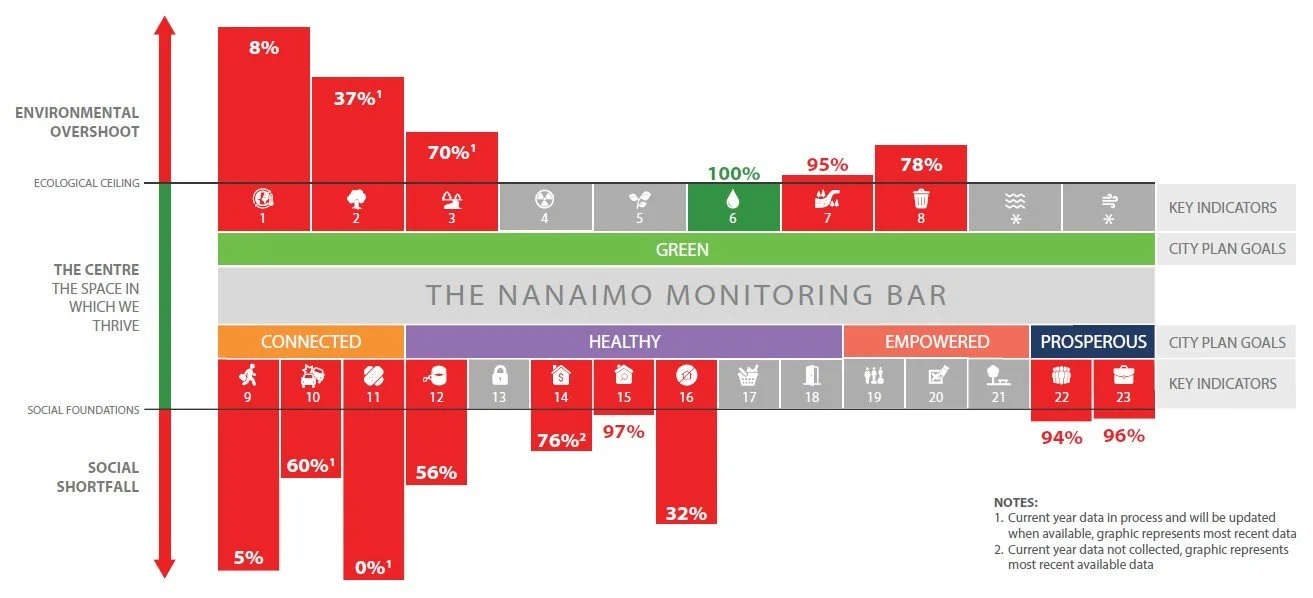
The Nanaimo Monitoring Bar, Reporting Year 2024 (visit website for for detailed legend)
The next step is action—real action. On the climate front, according to the Federation of Canadian Municipalities, municipalities play a critical role in climate action, with direct or indirect control over approximately 44% to 50% of Canada’s greenhouse gas (GHG) emissions. Local governments are essential for achieving national targets, as they influence urban development, transportation, and building energy. That’s a massive impact that underscores the importance of doing our part locally.
We, as Canadians, are currently living in environmental overshoot. While we meet many social needs we do so while far exceeding ecological limits. Our consumption and economic systems assume Earth’s resources are infinite. We are living outside our means and going into ecological debt. For a thriving future, we must learn to treat Earth’s resources like our bank accounts, and spend within our limits, or pay the price later.
No, Overshoot Day is not a day to celebrate. Nor is it another day to merely let pass by without noticing; it is a warning sign. What will you do this Overshoot Day to make a difference?