

Introducing the Nanaimo Climate Voting Records Tool
Written by Deanna Fourt, Policy & Advocacy Working Group Lead
For a long time I have understood that real climate action happens at the municipal level. Over a four-year term, our city mayor and councillors make thousands of decisions that shape how our city is developed, planned, operated, and conserved. Their decisions affect citizens' health, well-being, safety, equity, and justice now and in the future. These decisions can have a massive impact on the local environment, climate systems, natural resilience to climate shocks and social fabric. That is why I was so relieved that our city had the foresight and courage to develop a city plan that takes these issues into account to guide its decisions.
When Nanaimo Climate Action Hub decided to develop a tool to track the policy voting records of the mayor and council, I immediately saw it as a way to see whether council was following the city’s own plan and working toward its goals. Bringing this project to life has been an interesting experience, showing what NCAH volunteers can do within the bounds of the City of Nanaimo’s publicly available data and the platform we used with permission from Climate
Fast. Climate Reality Project Canada funded the website hosting and supported NCAH in keeping the tool non-partisan and presenting the information clearly – without commentary – so users can see the policy impact of council votes. This allows people to view the results and ask our council why they did or did not support climate-positive policies.
To decide which votes are climate votes and whether they are climate-positive or climate-negative, the working group collaborated to identify seven categories of votes that affect climate, the environment, and community resilience:
low-emissions building
low-emissions transportation & mobility
conservation & greening Nanaimo
climate-resilient community
solid waste reduction
urban sprawl
Reconciliation
As we reviewed the data, it was also clear that some votes would have a greater impact on the key climate and environmental goals identified in the City Plan: Nanaimo ReImagined. To make these items easy to identify, we created a high-priority filter. With this decided, they began an iterative process of combing through over 2,400 votes to identify 152 that fit the identified categories.
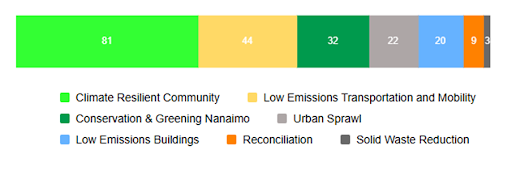
Number of Votes per Category (2022-Present)
NCAH volunteers also had to determine what voting item was climate-positive and what was climate-negative. A climate-positive item is one that, by either carrying or defeating it, will positively impact climate change. For example, voting against something that is a major contributor to climate change is a climate-positive vote. A climate-negative item is one that, by either carrying it or defeating it, will negatively impact climate change. For example, voting for developing forested lands, or greenfield sites, negatively affects the climate because it releases greenhouse gas emissions from the loss of forests and wetlands and reduces climate adaptation from natural systems; therefore, it is a climate-negative vote.
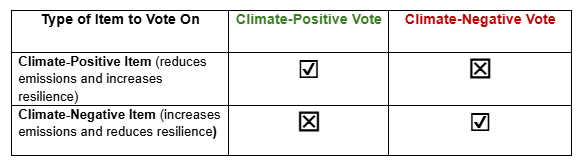
Climate-Positive vs Climate-Negative Vote
When you go to the main page of the Climate Voting Records tool, you will find a summary that shows how each councillor voted. Out of 152 votes, the fewest votes for climate-positive items is 114, and the most is 148. That may be an impressive result, showing the council could get important work done. But does that constitute a green council?
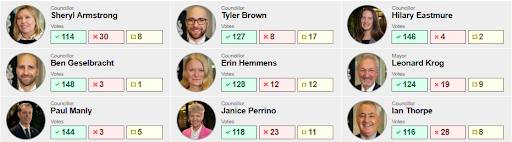
Climate Vote Summary by Councillor
To provide context on the impact of their decisions, NCAH added the High Impact Items graph to show who voted for climate when it really mattered. For this graph, we could ask why support wasn't 100% when it really mattered. Given that four, or almost half, of council voted against climate-positive items almost half the time, it suggests that council might not be as green as the overall summary suggests.
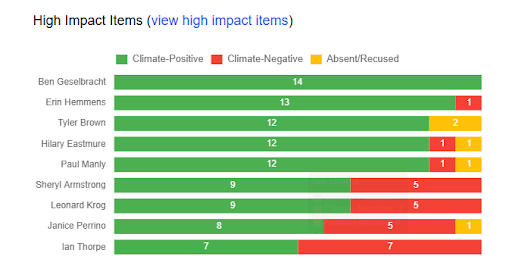
High Impact Items Chart
This is just one way to use the Nanaimo Climate Voting Records Tool. We hope you will take the time to look into this by clicking on each of the councillors to look further at their records and ask about it when you talk to the Mayor or Council, or better yet, when you vote in the municipal elections on October 17, 2026.