

Reflections from PNW Climate Week Vancouver
Written by Henry Sipos
The Pacific Northwest (PNW) Climate Week is an annual series of community-powered events focused on climate awareness and action. This year, for the first time, it was hosted cross-region, between British Columbia, Washington, and Oregon. 313 events were hosted across 6 cities – including Vancouver, BC – which meant I was able to attend several events. While there was a vast number of topics, the major themes that emerged were AI, LNG expansion, and data centres.
AI
AI was the hot topic of 2026, highlighting its potential to drive sustainability at the price of a massive energy footprint. While AI can be used to advance climate solutions, it was emphasized that not every issue needs an AI solution, as inappropriate use can be energy-intensive and costly.
LNG
LNG expansion brought some heated discussions. It is no secret that the federal government used the collective economic anxiety surrounding the 2024 United States presidential election as an opportunity to gain social approval for major traditional energy projects. The proposed LNG expansion projects lock Canada into a future of fossil fuel use, pushing the timeframe for achieving the goals set out in the Paris Agreement even further. This economic focus has come at the expense of progress toward renewables – including continued framing of First Nations as stakeholders offering equity and ownership, rather than as right holders to the land. While the government is investing millions into traditional energy infrastructure, the question arises: What are we choosing not to build?
At the PNW Climate Week, there were many small tech companies and startups that are investing in climate-smart solutions and clean energy projects. We have the technology, but we need the investment. Upfront capital is needed to develop carbon management. It is no surprise that, currently, much of this investment, particularly in developing carbon capture, is coming from traditional energy companies. While a collaboration between traditional and renewable energy is essential for the energy transition, traditional energy companies are using climate solutions to gain social approval and prolong the lifespan of fossil fuel use. However, as energy transition evolves, the economic argument to continue traditional energy use is becoming weaker.
Data Centers
Data centers were another contested topic. While there is a lot of public discourse and mobilization against the construction of data centers, we do need them for essential services. However, their resource intensity makes them burdensome for our environment and communities. The consensus was that until thorough regulation is developed, particularly around the environmental impacts and water usage, data centers should not be built.
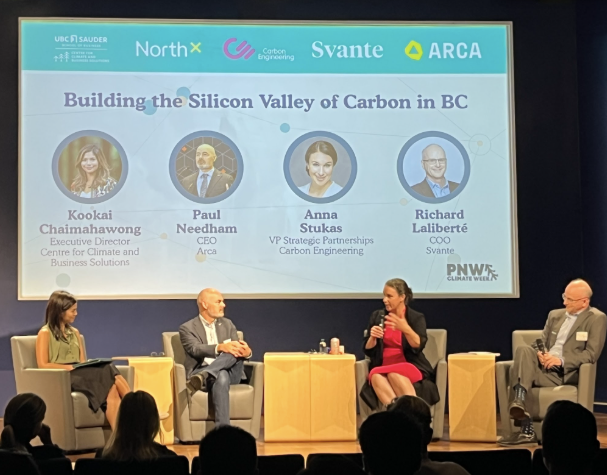
Panelists during the event “Building the Silicon Valley of Carbon in BC”
Solution
While the PNW presented many challenges, one solution was consistent across discussions: building community resilience. Energy democracy and sovereignty will be key to facing climate-change driven energy demand. We must prepare for both environmental, economical and social impacts of climate change, which requires a just transition to achieve successful outcomes for all.
Key takeaways
AI needs to be correctly used to be useful
Continued fossil fuel expansion is becoming economically unsound, a transition to renewable energy is inevitable
First Nations are not stakeholders but right holders
Data centers should not be built until environmental impacts and water usage regulations are developed
Community resilience is key to overcoming climate change driven challenges
The climate emergency is a symptom of a vast polycrisis – one of the many issues arising from the intersection of multiple systems and policy failures. Of course, a crucial component is the people existing within these systems. The PNW Climate Week highlighted that people are changemakers within their own capacity, capable of influencing their families, workplaces, communities, and governments. Even if we don’t have green jobs, on a small scale, we can all be activists and changemakers within our own fields driving forward and contributing to a more climate conscious future.